
How We Package Cold Plunge Chillers for Safe and Secure Delivery?

As a cold plunge manufacturer, Coldchiller understands the importance of proper packaging when shipping cold plunge chillers. Our packaging is designed to protect the chillers from shock, moisture, leaks, and scratches. We use a variety of methods to ensure they arrive in perfect condition. Read on to learn how we package our cold plunge chillers and ice bath tubs.

How Do We Package Cold Plunge Chillers to Ensure Safe Delivery?
As electrical products, cold plunge chillers require special attention during packaging — from pre-packaging inspection and preparation to careful selection of packaging materials and methods. At Coldchiller, we take packaging seriously to ensure each unit arrives intact and undamaged.
Quality Inspection Before Packaging
Before any cold plunge water chiller is packaged, we perform a thorough quality inspection to ensure it functions properly and is ready for regular use. Only after passing this inspection do we proceed with the packaging process.
Chiller Packaging Steps
For the packaging of chillers, we use a variety of protective methods to ensure that the machines are delivered to customers intact.
We use a multi-layer packaging approach for chillers, typically placing them in sturdy cartons. First, we wrap the chiller with protective film, followed by a layer of stretch film. Pearl foam is placed on the top and bottom of the unit for shock absorption and impact protection during transport. Critical components such as filters are also protected with additional foam.
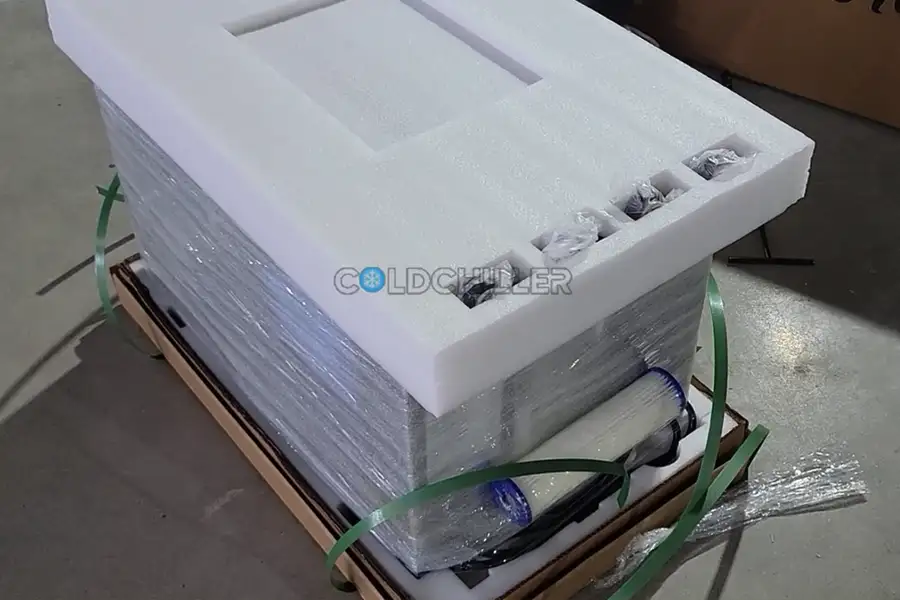
Once the chiller is secured inside the carton, we reinforce it with strong strapping to prevent shifting or damage during transit. Finally, the entire carton is wrapped in stretch film to provide added protection against moisture and scratches.

Special Packaging Notes
If you ordered only the chiller, it will be placed inside a custom wooden crate and loaded into the container.
If you also ordered an ice bath tub, we’ll pack the chiller inside the ice bath tub to save space and reduce shipping costs.
Pre-Packing Checklist for the Chiller
Before final packing, we check the following:
- Ensure all water has been drained from the chiller.
- Verify that all labels are present and correctly applied.
- Confirm that the nameplate information (weight, voltage, etc.) is accurate.
- Check that all accessories (filter element, water hose, filter wrench, universal wheels) are included.
- Confirm that the plug type matches the customer’s order.
- Ensure all screws are properly tightened and none are missing.
How Do We Package Ice Bath Tubs to Ensure Safe Delivery?
While packaging ice bath tubs may seem straightforward, it actually involves careful attention to detail to ensure each unit arrives in perfect condition.
Just like with our chillers, we begin the process with a thorough quality inspection. This includes checking that the wood is straight, undamaged, and meets our quality standards.
Ice Bath Tub Packaging Steps
We start by wrapping the tub for ice bath with stretch film. This film helps protect the tub from dust, moisture, and scratches during transit while also improving overall stability.
Next, we place the tub into a custom wooden crate. A layer of protective film is inserted between the tub and the crate to provide additional cushioning and prevent friction during transport.
Other components and accessories — such as steel bands, seats, and fittings — are also packed securely within the crate.
Packaging with Chillers
If you also purchase one of our chillers, we will package the chiller first and then place it inside the ice bath tub before crating. This efficient method helps save space and reduce shipping costs.
How Is Refrigerant Transported? Is It Safe?
Refrigerant can be transported in two ways. One is shipped with cold plunge chillers. If some countries allow refrigerant to enter the relevant area and the customer wishes to use the product immediately upon receipt, we will pre-fill the chiller with refrigerant.
The other is shipped empty. If some regions restrict refrigerant imports and the customer wishes to refill the chiller upon receipt, we will evacuate the chiller of refrigerant. The customer will then need to refill the chiller locally upon receipt.
Regarding refrigerant imports, different countries have different requirements. For example, equipment containing refrigerants entering the EU is subject to refrigerant quota management and filing, with a preference for refrigeration equipment using low-GWP or natural refrigerants (such as R290 and R600a). Therefore, customers should be aware of local regulations before purchasing chillers.
To ensure safe refrigerant transportation, we perform leak tests and pressure checks before packaging and provide protective packaging to prevent vibration and tilt.
The refrigerants used in COLDCHILLER refrigerators are typically R410A, R290, and R32. Refrigerators with ETL, PSE, and SAA certifications typically use R410A. Refrigerants shipped to North America are compatible with R32. Chillers with CE certification usually use R290 refrigerant.
Refrigerant types include hydrofluorocarbons (HFCs), hydrochlorofluorocarbons (HCFCs), hydrofluorocarbons (HFCs), and natural refrigerants. The first two are banned or restricted because they contain ozone-depleting chlorine, while the latter two are more common in refrigerators, air conditioners, and other refrigeration equipment.
R410A is a hydrofluorocarbon (HFC) refrigerant that is highly efficient and environmentally friendly and is commonly used in commercial and residential air conditioning. R32, also a hydrofluorocarbon (HFC) refrigerant, is more common in air conditioning and refrigeration equipment.
R290 is a natural refrigerant that contains no chlorine and does not deplete the ozone layer. Its main component, propane, is derived from natural gas and petroleum, making it completely biodegradable and environmentally friendly. We have recently launched the R290 refrigerant leak sensor, which can issue a warning when refrigerant leaks to ensure user safety.
Cold Plunge Chillers Inspection and Unpacking Tips
Upon receipt, customers should carefully inspect the outer packaging, examine the unit after unpacking, and ensure all key components are present. If any issues arise, please contact our customer service team immediately for assistance.
Inspecting the Outer Packaging
Upon arrival of your cold plunge chillers, do not rush to sign for them. In the presence of logistics personnel, inspect the outer packaging for intactness. Check for damage, dents, or other signs. Check if the wooden box is loose or damp. If any such signs are found, take photos for evidence and contact customer service.
Post-Unpacking Inspection
Carefully remove the outer packaging and cushioning materials—such as foam and film—so as not to damage the unit. After unpacking, inspect the chiller for scratches, paint peeling, or any physical damage.
Check that the power cord, plug, water inlet and outlet pipes, and other accessories are intact and not missing. Ensure the instruction manual, warranty card, and customer service contact information are also included in the package.
Do Not Use the Cold Plunge Chiller Immediately
If your water chiller for cold plunge contains refrigerant, do not power it on immediately. It’s best to wait for 24 hours for the refrigerant to settle to prevent it from flowing back into the compressor and affecting cooling performance.
FAQ
Below are some frequently asked questions from our customers. We hope these answers help! If your question isn’t listed here, feel free to contact us anytime.
How Long Does the Refrigerant Last? How Often Does It Need to Be Refilled?
In a well-sealed cold plunge chiller, the chiller’s energy is not consumed. Theoretically, it can be used for an extended period without regular refilling. Refilling is only necessary if a refrigerant leak occurs. Click the link to learn how to refill the chiller. Note: If refilling is necessary, always have a qualified professional perform the procedure.
What Does Your Chiller After-Sales Service Include?
Our chiller after-sales service includes a one-year warranty, lifetime technical support, and original parts supply. Choosing ColdChiller means choosing peace of mind and professionalism.
Is the Chiller Installation Complicated?
The chiller is easy to install. Simply connect the water pipes, plug in the power cord, and power it on. If you need assistance, we can provide immediate technical support and even create installation videos to assist with the installation.
Does the Chiller Consume a Lot of Electricity?
Our chiller does not consume much electricity. According to the ColdChiller manufacturer, when the ambient temperature is 36°C and the water temperature is 25°C, in a well-ventilated environment, it takes approximately five hours and consumes 4-5 kWh of electricity to cool 400 liters of water to 3°C. The electricity consumption is less than 1 kWh per hour, so the daily cost is low.
If you’d like to learn more about our chillers, please contact our professional team. We’re available 24/7 to answer your questions.
Get A Quote

Contact Me
Related Post You May Also Like
Ice Plunge Chiller Spacing: How Far Apart Should 2 Units Be?
[pac_divi_table_of_contents exclude_headings_by_class="include" included_headings="off|on|on|off|off|off" active_link_highlight="on" level_markers_3="icons" title_container_padding="10px|15px|10px|15px|true|false" title_container_bg_color="#333333"...

How to Manage Condensation Water in an Indoor Cold Plunge?
[pac_divi_table_of_contents exclude_headings_by_class="include" included_headings="off|on|on|off|off|off" active_link_highlight="on" level_markers_3="icons" title_container_padding="10px|15px|10px|15px|true|false" title_container_bg_color="#333333"...
Water Flow Insufficient for Water Chillers for Ice Bath: Causes and Solutions
[pac_divi_table_of_contents exclude_headings_by_class="include" included_headings="off|on|on|off|off|off" active_link_highlight="on" level_markers_3="icons" title_container_padding="10px|15px|10px|15px|true|false" title_container_bg_color="#333333"...

Best Cold Plunge Tub for Tall People: Buying Guide
[pac_divi_table_of_contents exclude_headings_by_class="include" included_headings="off|on|on|off|off|off" active_link_highlight="on" level_markers_3="icons" title_container_padding="10px|15px|10px|15px|true|false" title_container_bg_color="#333333"...
0 Comments