
Cold Plunge Pumps Upgrade: Easier Pump Replacement with an Access Panel

Cold plunge is transitioning from a niche hobby into a standard fixture in professional recovery and high-end lifestyles. Along with this trend, the cold plunge chiller is quietly evolving as well. Among its components, there lies an unassuming yet critically important part: the cold plunge pumps. Its role goes beyond the simple task of keeping the water flowing; it directly impacts cooling efficiency and the overall user experience.
Regarding cold plunge pumps installation, the market currently follows two primary design approaches: external pumps and internal pumps. The external cold plunge pumps solution is structurally simple but lacks aesthetic appeal. While the internal cold plunge pumps solution is aesthetically pleasing but troublesome to replace.
Consequently, when designing our next-generation cold plunge chiller, resolving this dilemma became a key focus. Our solution needed to preserve the sleek aesthetics of a fully integrated unit while simplifying the cold plunge pumps replacement process. COLDCHILLER’s ultimate answer to this challenge was to design a dedicated independent service access “window” specifically for the water pump.
This is not only an adjustment to a component’s structure, but also constitutes a fundamental optimization of the user experience. So, how is this design actually achieved? And which long-standing user pain points in traditional designs does it address? This article will provide a detailed breakdown of how this design upgrade evolved from concept to reality.
Next-Generation Ice Bath Chiller Launch: A Breakthrough in Maintenance Experience
After multiple rounds of R&D and rigorous testing, the all-new COLDCHILLER cold plunge chiller has officially made its debut—ready to redefine your cold plunge experience.
In the design of these new-generation ice bath chillers, we not only focused on the two key metrics of cooling performance and stability, but also re-evaluated the user’s maintenance experience during long-term operation. We have noticed that for those frequently used cold plunge equipment —particularly in commercial settings— replacing the water pump has become a major pain point for users.
Therefore, in the new generation of cold plunge chillers, we have optimized the maintenance method of the pump and added an independent access panel for the cold plunge pumps. Users can directly inspect and replace the water pump without complicated disassembly procedures.
The Critical Role of Cold Plunge Pumps in Chiller Systems
The importance of the cold plunge pumps, without saying, it serves as the “heart” of the entire circulation system. The role of the water pump is not only simply “transport water”, but also responsible for driving water flow to continuously circulate throughout the entire cooling system.
For this reason, its stable running directly affects three things: the cooling speed (the cold plunge pumps’ flow rate determines heat exchange efficiency), whether the water temperature is uniform (the flow prevents localized overcooling or overheating), and whether the filter runs stably.
Why Do Cold Plunge Pumps Require Regular Replacement?
In terms of usage habits, many users keep their chillers running around the clock. Among all key components, the water pump is actually the longest-running component of the entire cooling system—unlike the compressor that automatically starts and stops based on temperature, the cold plunge pumps keep running as long as the unit turns on.
Long-term high-load operation would accelerate the wear of the bearings and impellers. Furthermore, if the filter is not replaced in time, hair or minerals in the water may clog the pump body. Or you may forget to exhaust air and prime the pump when changing the pump or water, causing the water pump to run dry… For these various reasons, the water pump often becomes the first core component that needs to be replaced in the entire unit.
Therefore, for users, replacing the cold plunge pumps is not merely a simple repair issue; it is an unavoidable part of the long-term user experience. And this is exactly what we believe is worth redesigning.
External Cold Plunge Pump Systems: Pros and Cons
For compact models, home-use machines, and users who prefer DIY gameplay, the external cold plunge pumps solution is an economical and affordable option. In this solution, the chiller, the pump, the filter unit, and the bathtub are typically three separate devices, and they are connected by pipelines.
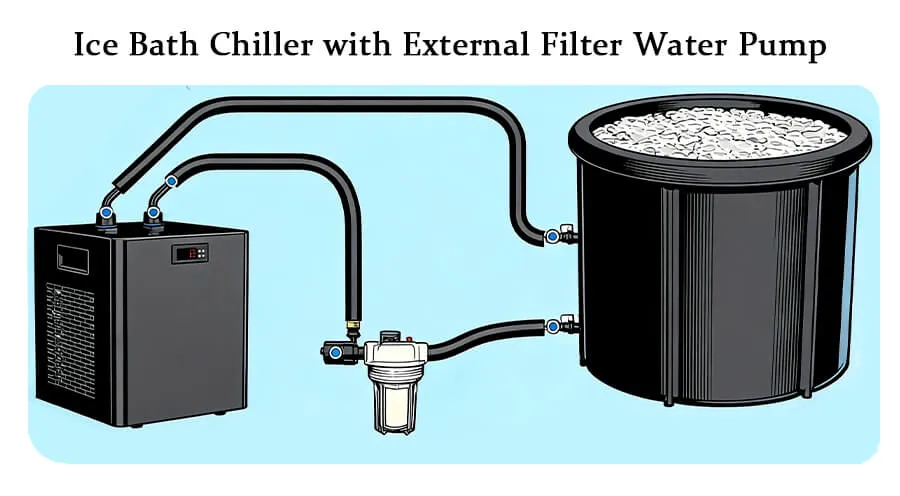
This solution can indeed eliminate the hassle of replacing the cold plunge pumps—since there is no housing, users touch the pump directly without having to remove anything.
Drawbacks of External Cold Plunge Pumps
The external cold plunge water pumps solution has the advantage of being flexible in replacement, but its disadvantages are also obvious.
Limited Visual Appeal
The first is the lack of aesthetic appeal. For mid-to-high-end markets such as rehabilitation centers and resort hotels that pursue band positioning, having the pump, pipes, and joints fully exposed is far less visually appealing than an integrated model.
Requires Manual Installation
Another, more practical issue lies in the installation process. This solution typically requires users to manually install the pumps, filters, hoses, and connectors after receiving the goods. A pump has at least 3 critical connection points: the pump inlet, the inlet and outlet ports, and the filter connection. If any of these are not installed properly, every connection point is a potential leakage point.
Therefore, the external cold plunge pumps solution relies heavily on user operation, and the installation quality can easily affect the user experience.
Built-In Water Pumps: Why the Industry Is Moving Toward Integration
In the early stages of cold plunge equipment development, external cold plunge pumps were widely adopted largely due to their lower cost, as well as the ease they offered for user assembly and component replacement. This “modular assembly” approach made sense for entry-level use scenarios.
However, as cold plunges evolve from personal experimentation to professional recovery and commercial operations mode, user priorities are shifting. Stability, hassle-free operation, and aesthetic appeal have been key factors in the user’s decision-making. In this context, integrated/all-in-one design has emerged as an important direction in the industry.
Traditional Built-In Cold Plunge Water Pump Designs: Pros and Cons
Many brands on the market have already introduced all-in-one cold plunge chillers. Simply put, the chiller, water pump, filter, and pipeline are all integrated into a single machine.
The benefits of this solution are clear: all installation steps are completed at the factory by skilled technicians, so users don’t need to connect any piping. The overall sealing, stability, and aesthetics have been significantly improved. On top of that, all operating parameters are preset before shipment, making it exceptionally hassle-free.
But there are always two sides to every story, and this traditional integrated design also faces pump replacement challenges.
The Biggest Limitation: Not Easy to Replace Cold Plunge Pump
When it is time to replace cold plunge pumps, the process for the traditional built-in water pump unit is a headache: first, you need to laboriously disassemble the upper cover of the entire machine, and then remove the pipes connected to the water pump one by one before installing the new pump. Next, you have to reconnect the pipes one by one, and finally screw the upper cover back on. The whole process is time-consuming and labor-intensive.
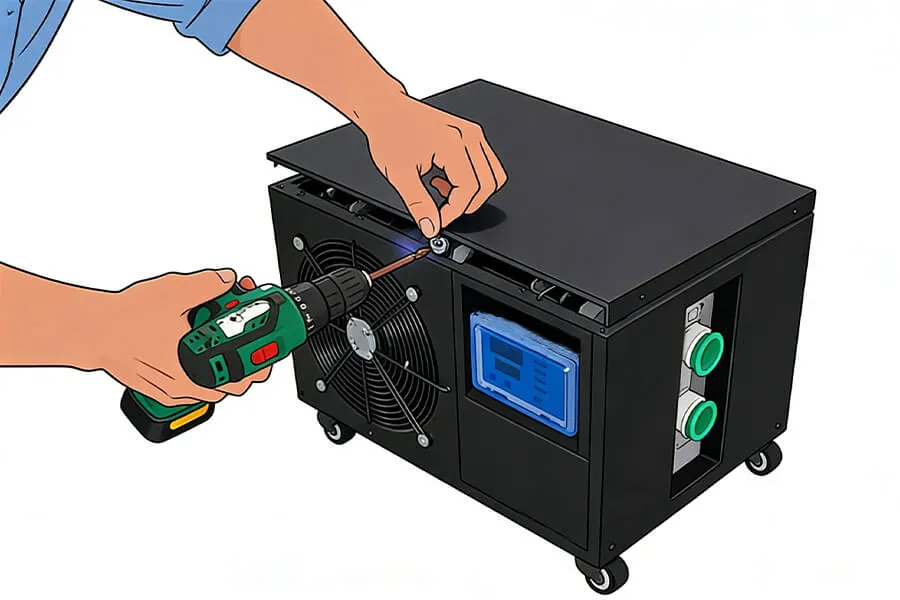
Redefining Maintainability in Integrated Systems: The Independent Pump Access Panel
To address this pain point, one of our core goals in developing COLDCHILLER’s new-generation ice bath chiller is to strike a balance between sleek design and ease of maintenance —preserving the premium integrated look while making pump replacement simple for users.
To this end, COLDCHILLER’s engineering team completely optimized the chiller’s internal layout, such as piping routes and component arrangement. The pump is no longer “hidden” deep inside the machine. Instead, an independent access panel has been added to the exterior. Users no longer need to disassemble the entire machine casing. They just open this panel to reach the pump for inspection or replacement.
Simple. Direct. Efficient
An integrated design that keeps its aesthetic appeal, while significantly reducing the complexity of after-sales maintenance—this is the real experience upgrade we aim to deliver to COLDCHILLER users through thoughtful engineering.
What the Pump Access Panel Means for Cold Plunge Users
For individual users, the pump access panel means that replacing cold plunge pumps no longer requires complex disassembly and assembly expertise, and there’s no need to worry about accidental errors affecting other components.
For dealers, commercial facilities—such as gyms and rehabilitation centers—experience high usage, leading to more frequent pump replacements. An access panel significantly reduces repair time: downtime is drastically minimized, , and equipment can be back in operation faster.
Conclusion
Our next-generation cold plunge chiller introduces a structural upgrade focused on one of the most common user pain points: ease of maintenance. By optimizing the internal architecture and adding an independent pump access panel, servicing critical components is now more direct and efficient.
Whether for individual users seeking a smoother ownership experience or for commercial operators with higher demands on system reliability and maintenance costs, this represents a more mature and well-engineered solution.
The new generation of cold plunge chillers is now officially launched. If you’re looking for a system that combines the benefits of an integrated design with true serviceability, this latest model is well worth a closer look.
FAQs
Question 1:Many chillers on the market utilize external water pumps; why did you opt for a built-in water pump?
Answer:While external water pumps offer flexibility, they often lack aesthetic appeal. In contrast, the integrated design of a built-in water pump minimizes the uncertainties users face during self-installation.
To address the common issue of inconvenient maintenance associated with traditional built-in pump systems, we have implemented an upgraded, dedicated access panel. This allows for the inspection and replacement of the water pump without the need to dismantle the entire unit.
Question 2: What is the expected lifespan of the water pump? Does it require frequent replacement?
Answer:The lifespan of a water pump typically depends on usage frequency, water quality, and maintenance practices. Under normal operating conditions, frequent replacement is generally not required.
Question3:How often should the water pump be replaced?
Answer:Depending on usage frequency, we generally recommend replacing the water pump approximately once 2 year.
Get A Quote

Contact Me
Related Post You May Also Like

Cold Plunge Tub Buying Guide: Commercial vs Home Use
[pac_divi_table_of_contents exclude_headings_by_class="include" included_headings="off|on|on|off|off|off" active_link_highlight="on" level_markers_3="icons" title_container_padding="10px|15px|10px|15px|true|false" title_container_bg_color="#333333"...
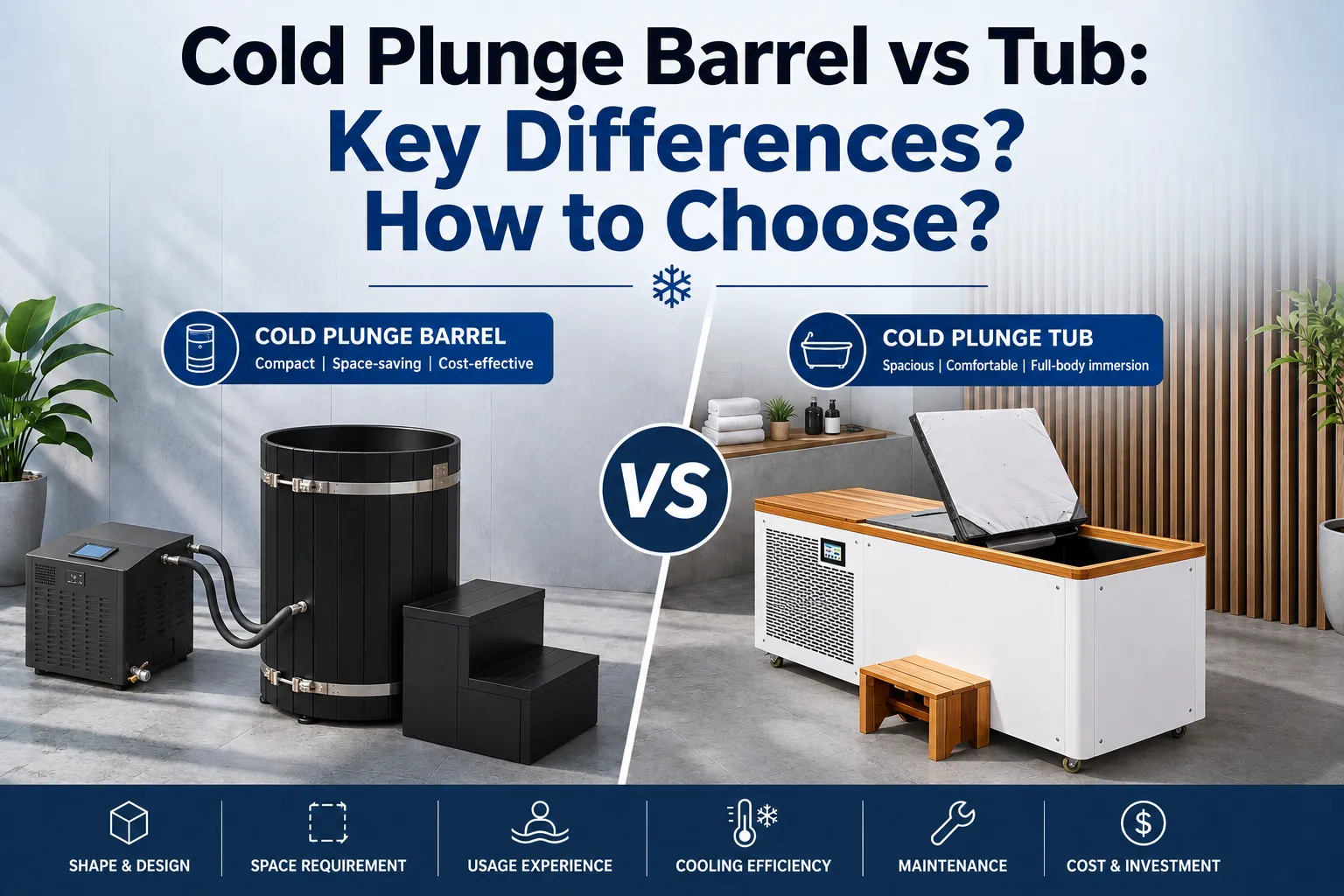
Cold Plunge Barrel vs Tub: Key Differences?How to Choose?
[pac_divi_table_of_contents exclude_headings_by_class="include" included_headings="off|on|on|off|off|off" active_link_highlight="on" level_markers_3="icons" title_container_padding="10px|15px|10px|15px|true|false" title_container_bg_color="#333333"...

Cold Plunge Chiller Transport:Fumigation Guidelines
[pac_divi_table_of_contents exclude_headings_by_class="include" included_headings="off|on|on|off|off|off" active_link_highlight="on" level_markers_3="icons" title_container_padding="10px|15px|10px|15px|true|false" title_container_bg_color="#333333"...

The Sauna & Ice Bath Opportunity You Can’t Ignore
[pac_divi_table_of_contents exclude_headings_by_class="include" included_headings="off|on|on|off|off|off" active_link_highlight="on" level_markers_3="icons" title_container_padding="10px|15px|10px|15px|true|false" title_container_bg_color="#333333"...
0 Comments