
Chiller for cold plunge: Winter Drainage, Storage Guide
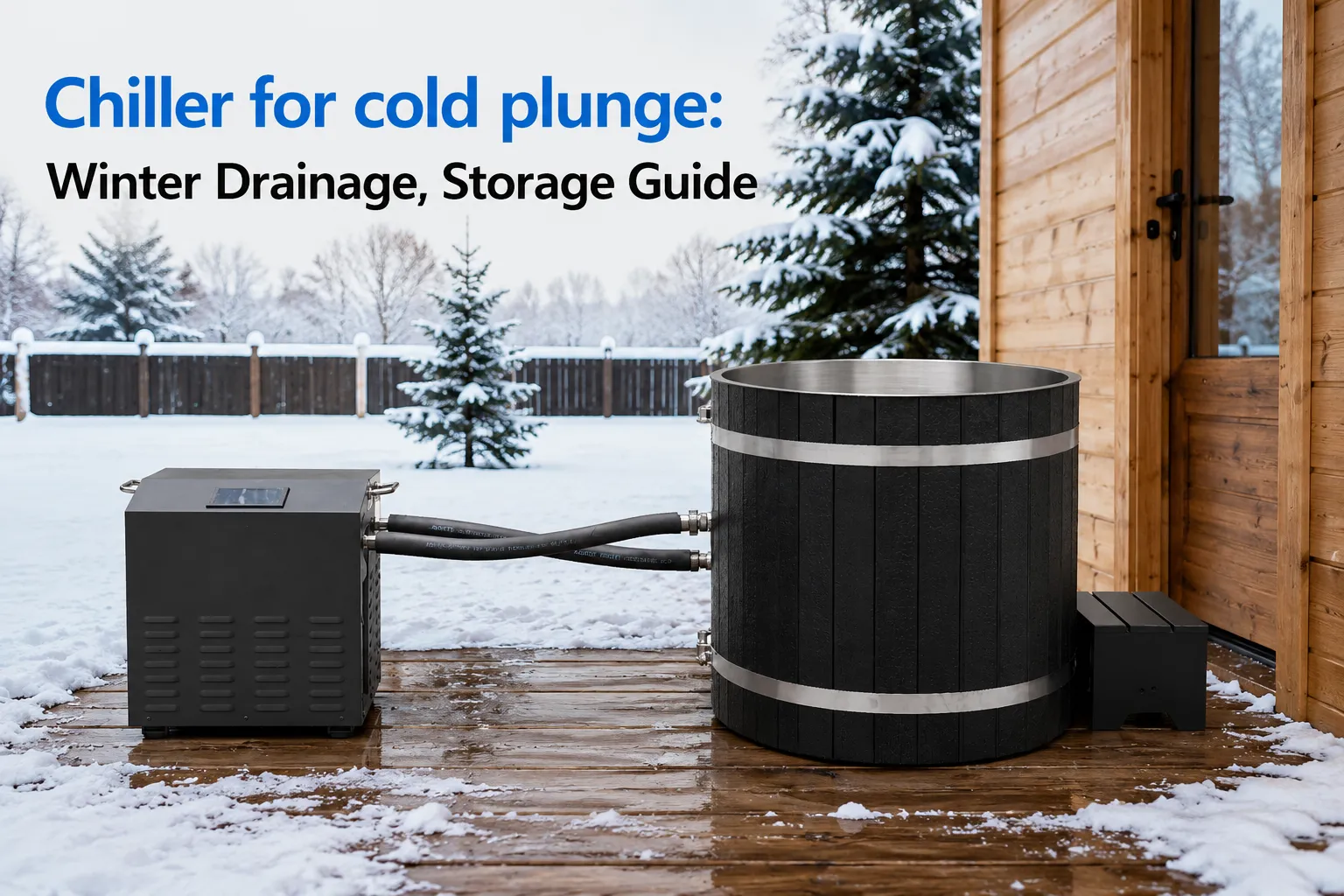
When the ambient temperature drops below freezing, if the chiller for cold plunge is not completely drained, residual water inside may freeze and cause the titanium heat exchanger to crack.
Therefore, winter chiller for cold plunge maintenance should not only address the tub but also include draining and storing the water circuit inside the chiller for cold plunge according to the equipment design.
For a chiller ice bath supplier, providing clear winter maintenance guidelines also helps buyers understand how different temperature conditions affect equipment use and storage. With this in mind, this article introduces winter maintenance methods for outdoor ice bath chillers.
Why Drain the System in Winter: The Impact of Freezing on an Ice Bath Chiller System
The fundamental reason for draining the system in winter is related to the physical properties of water. For outdoor chillers, winter drainage should first take into account the risk of freezing caused by low nighttime temperatures. When water freezes into ice, its volume expands by approximately 9%.
An outdoor chiller for cold plunge typically contains a heat exchanger, water pump, filtration system, and inlet and outlet water lines.
These components are not simply arranged in a straight-through structure, and some areas may have bends, low points, or residual water that cannot be easily drained by gravity.
When the chiller for cold plunge equipment stops running and the ambient temperature drops below freezing, residual water may freeze and put pressure on the pipe walls, connections, valves, and other components.
Some damage may not be immediately visible from the outside of the equipment. Small cracks in the water circuit may only cause problems such as water leaks or abnormal circulation when the system is refilled and operated again.
Therefore, during seasonal shutdown, the tub, chiller for cold plunge water circuit, connecting pipes, and filter should all be addressed.
When Should Cold Plunge Equipment Begin Winter Maintenance?
Winter maintenance does not need to wait until the equipment has already frozen. The lowest nighttime temperature is an important reference for determining when to begin maintenance.
Approaching 35°F–36°F / 2°C: Start Preparing for Winter Maintenance
When the lowest nighttime temperature remains close to 35°F–36°F (around 2°C), you can start preparing for winter maintenance.
At this stage, monitor temperature changes over the next few days and prepare drainage tools, a suitable storage space, and the necessary accessories.
Reaching 32°F / 0°C: Entering the Freezing Risk Range
32°F / 0°C is the freezing point of water.
If the equipment does not have a dedicated freeze-protection function, when the environment where the equipment is located may continuously reach or fall below this temperature, the decision to continue operation or perform a seasonal shutdown should be based on the equipment’s usage plan and the manufacturer’s requirements.
Sustained Below Freezing: Consider Seasonal Shutdown
If temperatures are expected to remain below freezing for an extended period, especially when the equipment will be unused for a long time or power outages are possible, seasonal shutdown and complete drainage should be given priority.
Even when the equipment is running, power outages, equipment failures, clogged filters, or reduced water flow can affect water circulation.
In prolonged freezing conditions, seasonal shutdown is generally more suitable for equipment that will remain unused for an extended period.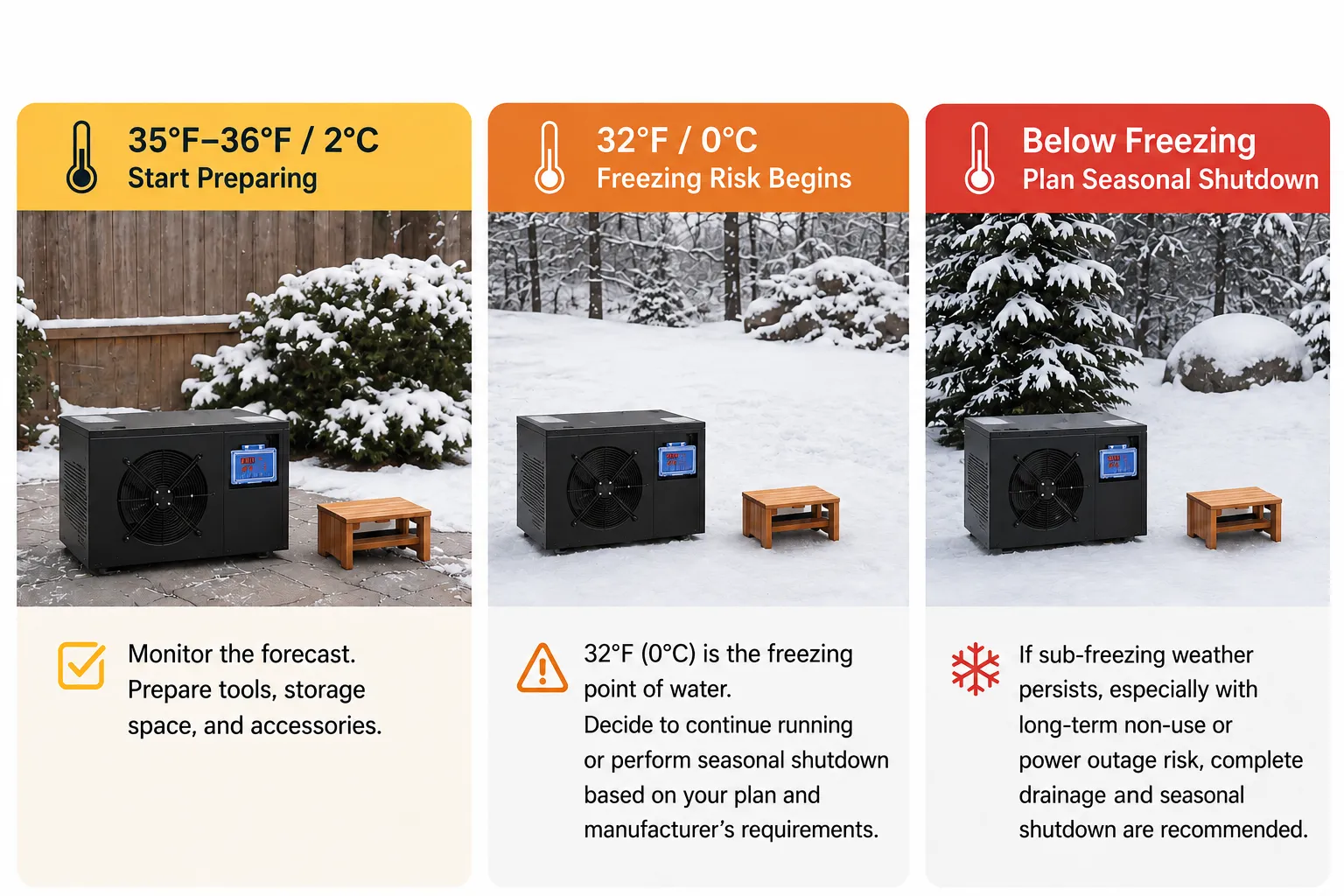
Winter Use or Seasonal Shutdown? How to Choose the Right Maintenance Method
There are two main approaches to using ice bath equipment in winter.
For ice bath equipment installed outdoors, whether to continue using it through winter or shut it down seasonally mainly depends on the local temperature, frequency of use, the possibility of power outages, and the equipment’s low-temperature operating requirements.
Continue Using the Equipment in Winter
When the winter climate is relatively mild and the cold water bath equipment needs to remain in use, the equipment can continue to operate.
Maintaining normal water circulation helps reduce the risk of rapid freezing in parts of the water circuit. Therefore, when using the equipment in winter, pay attention to the operating condition of the water pump and the circulating water flow.
The filter should also be checked regularly.
The risk of power outages also needs to be considered. In the event of heavy snow, extreme weather, or a power failure, the water pump may stop working, and the water inside the equipment may gradually freeze in low temperatures.
In the event of a prolonged power outage, the equipment should be handled promptly according to the local temperature and the product instructions.
Seasonal Shutdown and chiller winterizationWinter Use or Seasonal Shutdown? How to Choose the Right Maintenance Method
For equipment that will remain unused for an extended period during winter, follow the principles of chiller winterization by draining the tub, removing residual water from the chiller for cold plunge, servicing the filter, and moving the core equipment to a suitable storage environment where it can be kept above freezing throughout the storage period.
For chiller for cold plunge units designed for low-temperature operation or equipped with freeze protection, a winter shutdown may not always be necessary.
For example, Coldchiller provides operating instructions for certain low-temperature use conditions. Users can choose to continue operation or perform a seasonal shutdown based on the local temperature, equipment configuration, and actual frequency of use.
Drain Residual Water from the Chiller for Cold Plunge
After draining the tub, some residual water may still remain inside the chiller for coldplunge. The internal structure and drainage design vary between different chiller for coldplunge units, so the actual drainage method may also differ.
Allowing the water inside the chiller to drain out naturally may not completely empty the unit. There may be curved water lines, low-lying areas, or other parts inside the equipment where water is difficult to drain, leaving some residual water behind.
It is important to note that the chiller must never be tilted for drainage.
Coldchiller’s chiller for cold plunge can use a small self-priming water pump to remove residual water from inside the unit. After draining the tub and disconnecting the relevant water lines, the self-priming water pump can be used to extract the remaining water, reducing the amount of water that may be left behind through natural drainage.
This drainage method is more suitable for cold plunge equipment that is shut down seasonally outdoors and stored during winter. After pumping out the water, follow the equipment maintenance requirements for inspection and storage.
How Should an Outdoor Ice Bath Chiller Be Stored in Winter?
After drainage is complete, the chiller for cold plunge should be placed in a suitable storage environment.
Indoor, Dry, and Above-Freezing Environment
A chiller for cold plunge that is shut down seasonally should be stored in a dry, well-ventilated indoor space with a suitable temperature, such as a heated garage, basement, or storage room.
An indoor environment can maintain temperatures above freezing during winter, making it more suitable for winter storage.
Why Long-Term Storage in an Unheated Outdoor Space Is Not Recommended
Even after the water lines have been drained, a small amount of residual water or moisture may still remain inside the equipment.
If the internal water lines freeze, the chiller for cold plunge may be unable to establish normal water circulation after startup, which can prevent the equipment from operating properly.
Therefore, even a covered outdoor space that protects the equipment from rain and snow may still expose it to the risk of freezing if there is no heating.
How Should a Cold Plunge Tub Be Handled in Winter?
The tub can remain outdoors, but whether the chiller for cold plunge should also remain outdoors depends on the local low temperatures and the equipment requirements.
If the cold plunge tub in winter continues to be kept outdoors, wipe the inside dry during maintenance and cover it with a suitable insulated cover for outdoor use to reduce the entry of rain, snow, leaves, and dust.
Restarting the Chiller in Spring: A Complete Process from Inspection to Operation
Before putting the chiller for cold plunge back into operation in spring, do not power it on directly.
First check whether it has been affected by low temperatures, moisture, or changes to the connections during winter storage.
Then refill the system with water and remove any trapped air before starting the chiller.
1. Inspect the Equipment and Reconnect
After moving the chiller for cold plunge back to its installation location, inspect the inlet and outlet connections, hoses, and sealing rings.
If any sealing ring shows signs of aging, deformation, or damage, replace it according to the product requirements.
Then reconnect the inlet and outlet water lines and check that the quick connectors are properly locked.
2. Fill the Tub with Water
Fill the tub with clean water to the operating water level specified for the product, covering the inlet and outlet ports of the circulation system.
Do not start the circulation system when the water level is insufficient.
3. Bleed and Prime the Water Lines
Before starting the equipment, allow water to enter the water lines and pump.
If the equipment is equipped with an air release valve, follow the product instructions to gradually release air from the water lines until a stable water flow is established.
This step is important for reducing the risk of the pump running dry and startup issues.
4. Power On and Check the Water Flow
After confirming that the pump has been properly primed, connect the power supply and start the equipment.
During initial startup, observe the water flow and check whether the pump makes any unusual noises.
Also check the filter housing, quick connectors, hose connections, and the bottom of the chiller for cold plunge for any signs of water leakage. If you notice any abnormality, turn off the equipment promptly and check the connections.
5. Complete Water Quality Maintenance
After confirming that the circulation system is operating normally, perform water quality maintenance according to the chiller for cold plunge equipment and water treatment product instructions.
How to Choose a Reliable Outdoor Ice Bath Chiller Manufacturer?
When choosing an outdoor chiller for cold plunge, consider the equipment’s outdoor suitability, refrigeration system, water circulation, smart controls, and winter maintenance requirements, while also considering bulk supply, product customization, and market certifications.
Product Advantages of Coldchiller Outdoor Ice Bath Chillers
Coldchiller chillers feature a metal housing and outdoor-grade coating, making them suitable for use with outdoor cold plunge tubs.
The chiller for cold plunge can also be equipped with an LCD display, smart self-diagnostics, water pump protection, and Wi-Fi/APP control, making it convenient to monitor equipment status and manage the unit remotely.
Different cooling solutions are available, with R410A, R32, or R290 refrigerants as options. Some models can also be combined with a filtration system.
For winter maintenance, Coldchiller chillers can be designed around the seasonal use requirements of outdoor ice bath equipment, with comprehensive operating controls and protection functions.
Product Solutions from Coldchiller for B2B Buyers
Coldchiller provides standard chiller for cold plunge models as well as customization services for the appearance, control panel, packaging, and brand labeling, allowing products to be configured for different cold plunge tubs and market requirements.
During production, leakage, pressure, aging, and safety tests are conducted. Products with relevant CE, SAA, and ETL certifications or certification support can also be provided.
Get A Quote

Contact Me
Related Post You May Also Like
Ice Plunge Chiller Spacing: How Far Apart Should 2 Units Be?
[pac_divi_table_of_contents exclude_headings_by_class="include" included_headings="off|on|on|off|off|off" active_link_highlight="on" level_markers_3="icons" title_container_padding="10px|15px|10px|15px|true|false" title_container_bg_color="#333333"...
How to Manage Condensation Water in an Indoor Cold Plunge?
[pac_divi_table_of_contents exclude_headings_by_class="include" included_headings="off|on|on|off|off|off" active_link_highlight="on" level_markers_3="icons" title_container_padding="10px|15px|10px|15px|true|false" title_container_bg_color="#333333"...
Water Flow Insufficient for Water Chillers for Ice Bath: Causes and Solutions
[pac_divi_table_of_contents exclude_headings_by_class="include" included_headings="off|on|on|off|off|off" active_link_highlight="on" level_markers_3="icons" title_container_padding="10px|15px|10px|15px|true|false" title_container_bg_color="#333333"...

Best Cold Plunge Tub for Tall People: Buying Guide
[pac_divi_table_of_contents exclude_headings_by_class="include" included_headings="off|on|on|off|off|off" active_link_highlight="on" level_markers_3="icons" title_container_padding="10px|15px|10px|15px|true|false" title_container_bg_color="#333333"...
0 Comments